Steam until 1976
Stokers kept the boilers going, day and night, for more than eighty years
The roads still open. The power that moves them changed in 1976. The old engines are still there, in rooms you can visit.
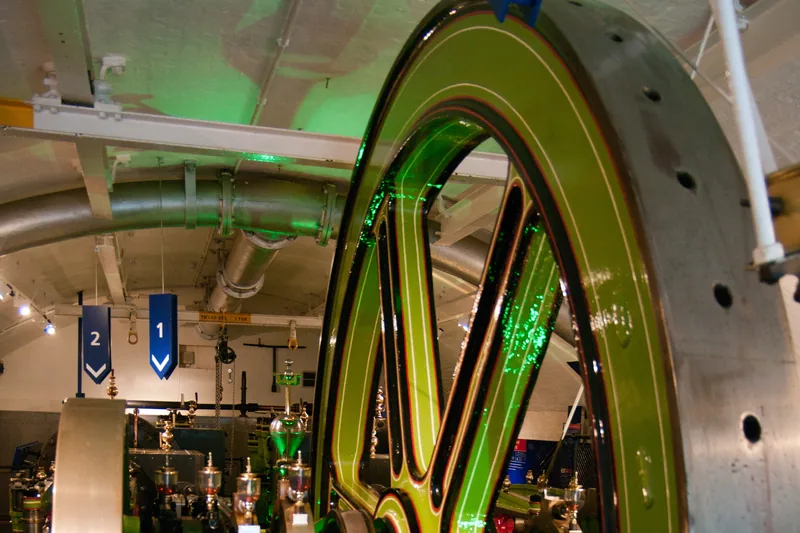
“When first built, Tower Bridge was the most sophisticated bascule bridge ever completed. The bascules were operated by hydraulics, using steam to power the enormous pumping engines.” That system had to be ready at any hour. Under the 1885 Act, a ship can still ask for a lift in the middle of the night. In the steam years, that meant the boilers could not be allowed to go out. [source] [source]
Boilers, a flywheel, and six accumulators
Three large boilers were “continuously fuelled by stokers working in shifts, 24 hours a day, to ensure there was enough energy available to lift the bridge whenever required.” Steam powered “the large steam pumping engines in the next room.” Their pistons “turn a large flywheel at the same time as powering a set of hydraulic pumps.” Those pumps pushed water “into six huge storage containers called accumulators,” which “act like batteries, storing the energy by holding the water under high pressure.” [source]
When the Bridge was required to open, “the water was released into the drive engines, powering yet more pistons to turn a set of cogs. These cogs connect to a rack on the back of the bascules.” Eight large cogs, “about 1m in diameter, four on each side,” did the hard work. Each bascule “moves around an off-centre pivot,” and each side is evenly balanced, “so less energy is required to open up the roads and no pressure is put on the Towers.” [source]
Why steam was given up
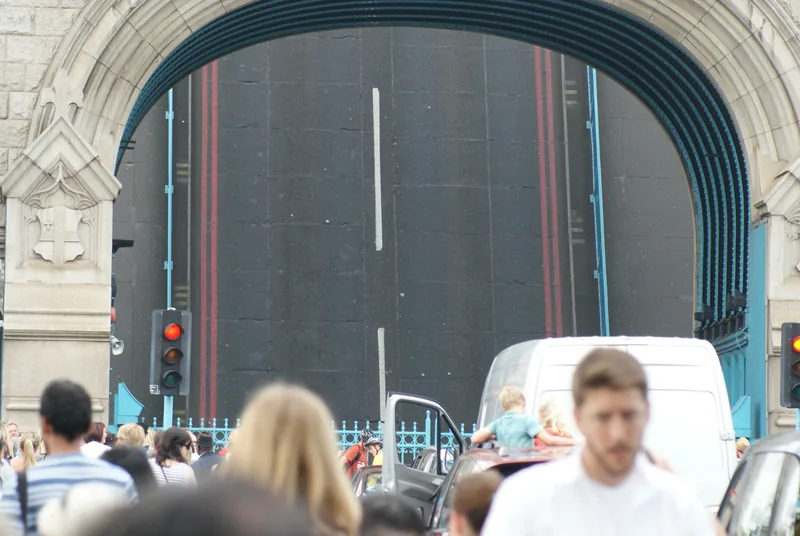
By the late 1960s, “Tower Bridge only opened a few hundred times a year (down from over 6,000 in the first year), and steam was no longer an efficient way to open it.” Installation of a new electro-hydraulic system “began in 1974.” Electric pumps created “oil-hydraulic energy to turn the cogs.” The new engines “were installed while the steam system was still in operation, so the Bridge could still open for passing river vessels.” [source]
“In 1976, the work was completed, Tower Bridge became fully electro-hydraulic powered. It has remained the same ever since, and the old system was disconnected.” Today the bascules “are still operated by hydraulic power, but are driven by oil and electricity rather than steam.” [source] [source]
The engines you can still visit
The Victorian Engine Rooms are still part of a visit. Since 1982, people have been able to see inside the Bridge, “including the High-Level Walkways, the Glass Floors, and the Victorian Engine Rooms, which house the beautiful steam engines that once powered the Bridge lifts.” The facts page says you can still see “the original pumping engines, accumulators and boilers on display.” The how-it-works page describes those engines as “brightly painted” and says they “resemble a steam train when they move.” They no longer lift the Bridge. The old system, that page says, was disconnected in 1976. [source] [source] [source]
Keep exploring
Enjoyed the Bridge?
No pop-ups. No intrusive advertising. Just interesting stuff. A little support helps the next landmarks site get built.