How it opens
Open a drawer
The seesaw roads, the steam, a colour rumoured to be Queen Victoria’s favourite, a cutter called Daisy, an architect who never saw the finished Bridge, glass floors, and sixty-four lifts in a day.
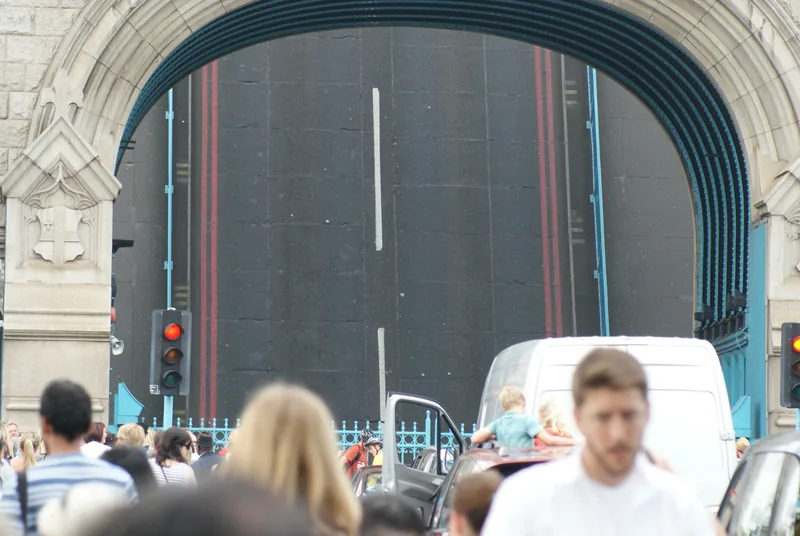
“It is not a drawbridge.” Sir Horace Jones first intended one, until “it was discovered that the roads would be too heavy for the towers to hold.” The answer was a bascule: two giant seesaws. Each leaf “moves around an off-centre pivot,” and each side is evenly balanced, “so less energy is required to open up the roads and no pressure is put on the Towers.” Eight large cogs, about a metre across, four on each side, do the hard work. They connect to a rack on the back of the bascules. [source] [source]
Open a drawer to look closer at the seesaw roads, a colour once rumoured to be Queen Victoria’s favourite, a cutter called Daisy, and engines that ran on steam until 1976.
It is not a drawbridge
“It is not a drawbridge.” Drawbridges “require ropes or chains to pull up the road, but Tower Bridge’s roads are too heavy to be opened like this. Instead, it is a bascule bridge, which means the roads (bascules) move like two giant seesaws and pivot to open and close the Bridge. The word bascule derives from the French for ‘see-saw’ or ‘balance’.” Each bascule “moves around an off-centre pivot,” and each side is evenly balanced, “so less energy is required to open up the roads and no pressure is put on the Towers.” [source] [source]
Steam ran the Bridge until 1976
“It used steam power until 1976.” When first built, “Tower Bridge was the most sophisticated bascule bridge ever completed. The bascules were operated by hydraulics, using steam to power the enormous pumping engines.” Stokers worked in shifts, 24 hours a day, to keep three large boilers going. In 1976 the work was completed and “Tower Bridge became fully electro-hydraulic powered.” The old engines are still there to see. [source] [source]
It was once bright chocolate brown
The official facts page says the original colour was “bright chocolate” brown, “rumoured to be Queen Victoria’s favourite colour.” “This colour scheme survived until battleship grey was applied as camouflage pre-WW2. In 1977, it was repainted the red, white and blue colours you can still see today, to celebrate Her Late Majesty The Queen’s Silver Jubilee.” [source]
The first vessel through was the cutter Daisy
The Prince of Wales opened Tower Bridge at 12pm on 30 June 1894, “accompanied by his wife, Princess Alexandra, and his son, the Duke of York (the future King George V). The first vessel through was the Harbour Master’s cutter, ‘Daisy’.” Nine days later, on a pedestrians-only day, around 141,760 people crossed, and the Bridge was lifted 13 times for 15 ships. [source]
The architect never saw it finished
After a competition was abandoned in 1879, “architect Sir Horace Jones teamed up with civil engineer Sir John Wolfe Barry, to adapt his previously rejected design.” Construction began on 22 April 1886. “Horace Jones passed away just one year into construction, leaving Barry to complete the project over the next eight years.” “Jones died one year into the Bridge’s construction and never got to see it finished.” [source] [source]
The glass floors can hold two black taxis
Glass floors were installed in the High-Level Walkways in 2014. The official facts page says they “can hold the weight of more than two black taxi cabs.” The two walkways, the construction timeline says, “stand 42m above the River Thames and stretch 61m between the two Towers of the Bridge.” Visitors have been able to go inside since 1982. [source] [source] [source]
Sixty-four lifts in a single day
“The highest-ever number of Bridge Lifts in one day was 64.” In the first year it opened more than 6,000 times. By the late 1960s it opened only a few hundred times a year. Under the 1885 Act, the City of London Corporation is required to raise the Bridge, free of charge, for registered vessels with a mast or superstructure of 30 feet or more, with 24 hours’ notice, day or night, 365 days a year. [source] [source] [source]
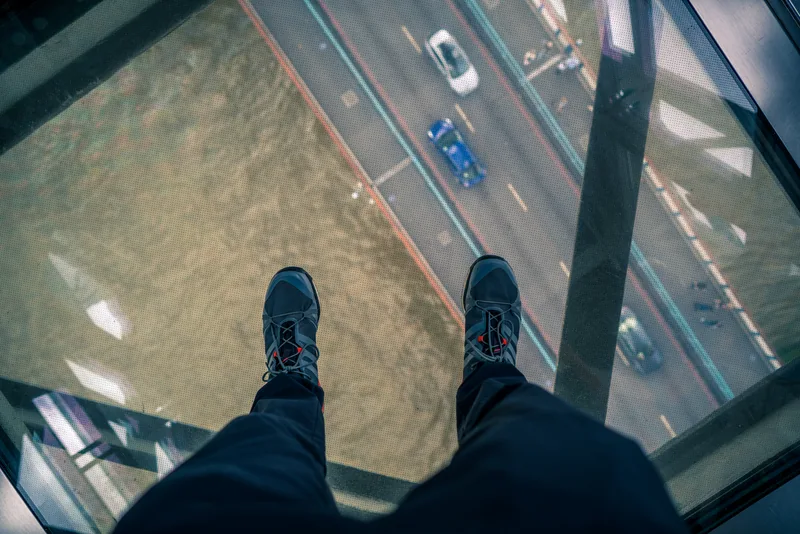
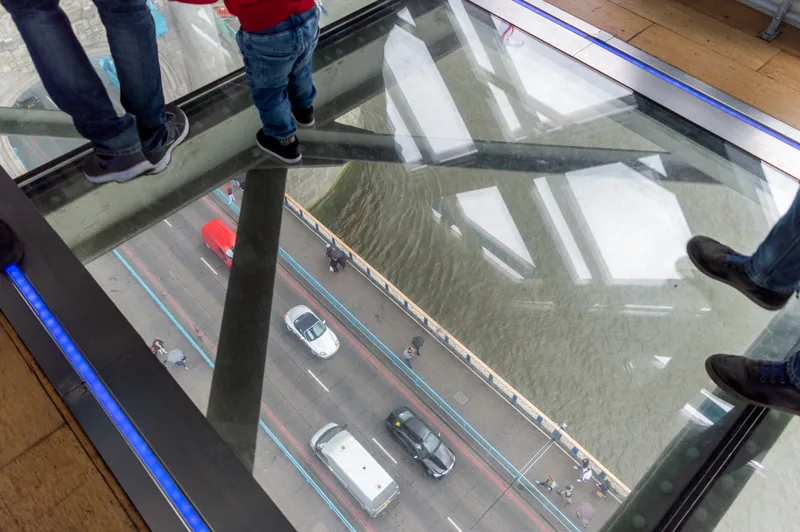
The High-Level Walkways stand 42 metres above the Thames and stretch 61 metres between the Towers. Visitors have been able to walk them since 1982. In 2014 they were fitted with glass floors that “can hold the weight of more than two black taxi cabs.” From up there the river traffic still has to be allowed through. Under the 1885 Act, a registered vessel with a mast or superstructure of 30 feet or more can still ask for a lift, free of charge, with 24 hours’ notice, at any hour of the year. The highest-ever number of lifts in one day is 64. [source] [source] [source]
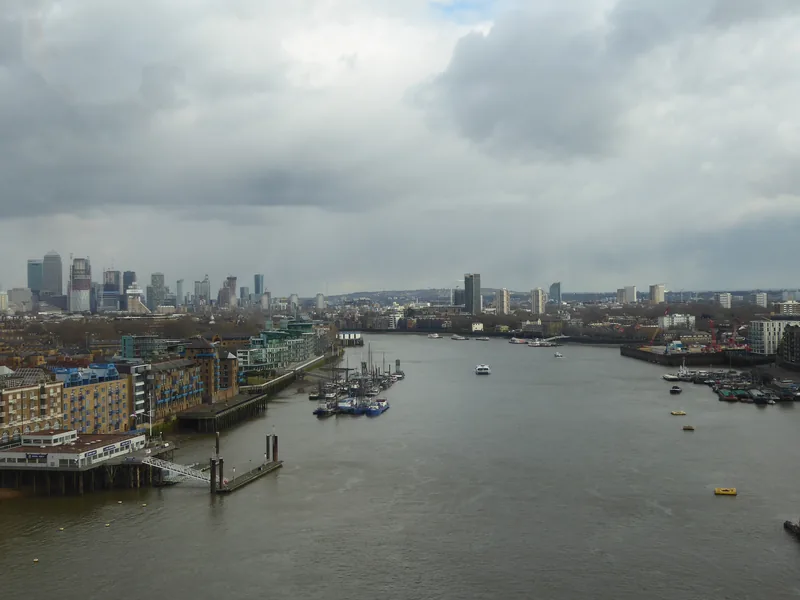
Steam ran those seesaws until 1976. Stokers had worked in shifts, 24 hours a day, to keep three large boilers going. The pumping engines pushed water into six accumulators, “like batteries,” and that stored pressure turned the cogs when a ship was due. Oil and electricity took over, and the old engines were disconnected — but they are still in the Victorian Engine Rooms, “brightly painted,” and official pages say they “resemble a steam train when they move.” [source] [source] [source]
Keep exploring
Enjoyed the Bridge?
No pop-ups. No intrusive advertising. Just interesting stuff. A little support helps the next landmarks site get built.