Fact file
85 sourced facts about Tower Bridge
Each line is taken from an official Tower Bridge page, or from a named photograph file. Notes on figures that official pages give differently sit on the sources page.
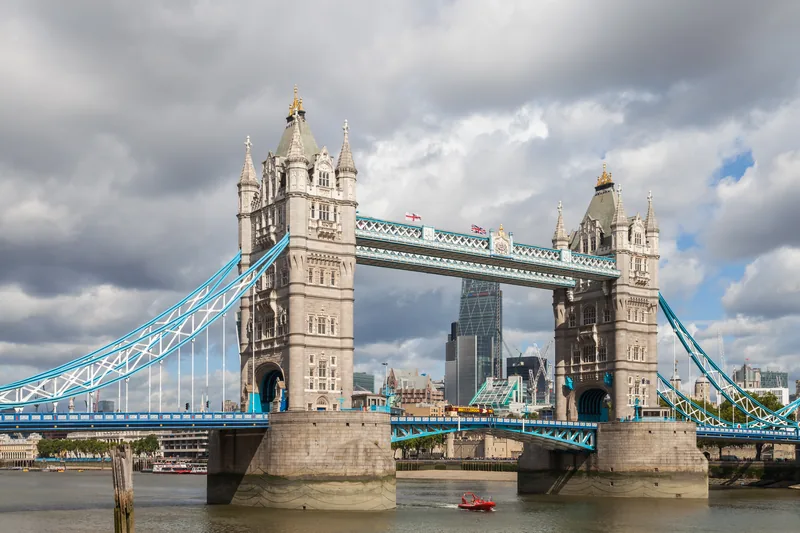
- Tower Bridge opened on 30 June 1894. [source]
- It was built “to ease road traffic while maintaining river access to the busy Pool of London docks.” [source]
- It is built by, owned and managed by the charity City Bridge Foundation, historically known as Bridge House Estates. [source]
- The Foundation also owns and maintains London, Southwark, Millennium and Blackfriars bridges, “at no cost to the taxpayer.” [source]
- The sole trustee of City Bridge Foundation is the City of London Corporation. [source]
- On 10 February 1876 the Corporation of London asked City Bridge Foundation to establish a Special Bridge or Subway Committee. [source]
- “Over 50 designs were submitted to a competition.” [source]
- After the competition was abandoned in 1879, “architect Sir Horace Jones teamed up with civil engineer Sir John Wolfe Barry, to adapt his previously rejected design.” [source]
- The Neo-Gothic style was “chosen so that it complemented the White Tower.” [source]
- The new design “was proposed to the Court of Common Council on 28 October 1884 and then to Parliament in November 1884, where it was approved.” [source]
- The Corporation of London (Tower Bridge) Act 1885 received Royal Assent on 14 August 1885. [source]
- Under that Act, the City of London Corporation “is required to raise the Bridge to provide access to and egress from the Upper Pool of London for registered vessels with a mast or superstructure of 30 feet or more.” [source]
- The lift service is “provided free of charge subject to 24 hours’ notice and is available any time, day or night, 365 days per year.” [source]
- Construction began on 22 April 1886. [source]
- Sir John Wolfe Barry was Chief Engineer; Henry Marc Brunel, Assistant Engineer; Edward Cruttwell, Resident Engineer. [source]
- “Horace Jones passed away just one year into construction, leaving Barry to complete the project over the next eight years.” [source]
- “Jones died one year into the Bridge’s construction and never got to see it finished.” [source]
- The first caisson was “sunk to a depth of almost 8m under the riverbed.” [source]
- “It took eight years, five major contractors and the relentless labour of 432 construction workers each day.” [source]
- “Around 31,000,000 bricks” were used, and “the foundations into the riverbed are at a depth of almost 8m.” [source]
- November 1884: three options were unveiled by Sir Horace Jones; with Sir John Wolfe Barry, a bascule design with a central opening span was accepted. [source]
- The power required to rotate the cogs “was initially supplied by steam and then, post-1976, by electricity.” [source]
- “Building the Bridge took eight years to complete and ran to a cost of over £1 million.” [source]
- The Bridge House Estates committee recorded that the Bridge cost £1,184,000. [source]
- In April 1894, Sir William Armstrong’s engineers lowered and raised the bascules for the first time. [source]
- On 21 June 1894 the bascules were weight-tested “with steam rollers, traction engines and loaded trollies exerting a pressure of 100 CWT (hundredweight) per square foot (54.68 tonnes per square metre).” [source]
- “The two Walkways stand 42m above the River Thames and stretch 61m between the two Towers of the Bridge.” [source]
- “The crests on top of our Towers are almost 63m above road level and are gilded with gold, and the length of central span between the Towers is almost 66m.” [source]
- The Prince of Wales opened the Bridge at 12pm on 30 June 1894, “accompanied by his wife, Princess Alexandra, and his son, the Duke of York (the future King George V).” [source]
- “The first vessel through was the Harbour Master’s cutter, ‘Daisy’.” [source]
- On 9 July 1894, pedestrians only, 5am to 9pm: “Around 141,760 Pedestrians crossed Tower Bridge on this day. The Bridge was lifted 13 times for 15 ships.” [source]
- From 29 July 1894 the Bridge was open day and night. “From July, an estimated 8,000 horse-drawn vehicles and 60,000 pedestrians are crossing the Bridge daily.” [source]
- “It is not a drawbridge.” [source]
- Drawbridges “require ropes or chains to pull up the road, but Tower Bridge’s roads are too heavy to be opened like this.” [source]
- “Instead, it is a bascule bridge, which means the roads (bascules) move like two giant seesaws.” [source]
- “The word bascule derives from the French for ‘see-saw’ or ‘balance’.” [source]
- Jones initially intended a drawbridge; “it was discovered that the roads would be too heavy for the towers to hold.” [source]
- “Each bascule moves around an off-centre pivot.” [source]
- “Each side of the bascule is evenly balanced, so less energy is required to open up the roads and no pressure is put on the Towers.” [source]
- “The hard work of opening and closing the Bridge is left to eight large cogs. These are about 1m in diameter, four on each side.” [source]
- “It used steam power until 1976.” [source]
- “When first built, Tower Bridge was the most sophisticated bascule bridge ever completed.” [source]
- The bascules “were operated by hydraulics, using steam to power the enormous pumping engines.” [source]
- Three large boilers were “continuously fuelled by stokers working in shifts, 24 hours a day.” [source]
- Steam powered “the large steam pumping engines in the next room.” Pistons turned a flywheel and powered hydraulic pumps. [source]
- Those pumps pushed water “into six huge storage containers called accumulators.” [source]
- When the Bridge was required to open, “the water was released into the drive engines,” turning cogs connected to a rack on the back of the bascules. [source]
- “By the late 1960s, Tower Bridge only opened a few hundred times a year (down from over 6,000 in the first year).” [source]
- Installation of a new electro-hydraulic system “began in 1974.” [source]
- “In 1976, the work was completed, Tower Bridge became fully electro-hydraulic powered. It has remained the same ever since, and the old system was disconnected.” [source]
- Today the bascules “are still operated by hydraulic power, but are driven by oil and electricity rather than steam.” [source]
- The original colour was “bright chocolate” brown, “rumoured to be Queen Victoria’s favourite colour.” [source]
- “This colour scheme survived until battleship grey was applied as camouflage pre-WW2.” [source]
- “In 1977, it was repainted the red, white and blue colours you can still see today, to celebrate Her Late Majesty The Queen’s Silver Jubilee.” [source]
- Since 1982 visitors have been able to see inside, including the High-Level Walkways, the Glass Floors, and the Victorian Engine Rooms. [source]
- Glass floors were installed in the Walkways in 2014 and “can hold the weight of more than two black taxi cabs.” [source]
- “The highest-ever number of Bridge Lifts in one day was 64.” [source]
- The Southwark parts of the Bridge were listed on 6 December 1949; the North Tower, in Tower Hamlets, was listed on 27 September 1973. [source]
- “The Tower Bridge Act of 1885 states that the Bridge is to be opened free of charge for river traffic.” [source]
- A 1894 Rijksmuseum photograph, released as CC0, shows the Bridge under construction. The photographer is not named. [source]
- A Cassier’s Magazine print by Messrs. Valentine & Sons shows the opening day, 30 June 1894, with the bascules raised. [source]
- Diego Delso photographed the Bridge from the river on 11 August 2014. [source]
- Robert Lamb photographed a raised bascule on 12 July 2014. [source]
- Nan Palmero photographed the glass floor on 7 September 2022. [source]
- Pierre Blaché photographed the roadway at sunrise on 4 August 2019. [source]
- Bob Collowan photographed the Bridge from The Shard on 18 July 2013. [source]
- Dirk Ingo Franke photographed a steam pumping engine on 14 August 2014. [source]
- Martin Falbisoner photographed the Bridge at night on 26 March 2013. [source]
- Dietmar Rabich photographed the Bridge with the Tower of London on 9 October 2016. [source]
- Tristan Surtel photographed the east walkway’s glass floor on 25 April 2018. [source]
- Marathon photographed the view from the east walkway on 26 February 2018. [source]
- The official “How does Tower Bridge work?” page translates bascule as “seesaw.” [source]
- The Bridge is still a working crossing as well as a visitor attraction. [source]
- The how-it-works page describes the original pumping engines as “brightly painted” and says they “resemble a steam train when they move.” [source]
- The facts page says you can still see “the original pumping engines, accumulators and boilers on display in the Engine Rooms.” [source]
- The accumulators “act like batteries, storing the energy by holding the water under high pressure.” [source]
- The new electro-hydraulic engines “were installed while the steam system was still in operation, so the Bridge could still open for passing river vessels.” [source]
- Electric pumps created “oil-hydraulic energy to turn the cogs.” [source]
- “Each bascule moves around an off-centre pivot, meaning they look a bit like a seesaw in a children’s playground.” [source]
- The official About page’s opening line is simply: “Opened on 30 June 1894.” [source]
- The official About page still describes the Bridge as a working crossing as well as a visitor attraction. [source]
- A drawbridge “was actually how Tower Bridge’s architect, Sir Horace Jones, initially intended the roads to open.” [source]
- The High-Level Walkways “were fitted with Glass Floors in 2014.” [source]
- From 29 July 1894 the Bridge was “open day and night.” [source]
- The Special Bridge or Subway Committee was set up after the Corporation of London’s request of 10 February 1876. [source]
Keep exploring
Enjoyed the Bridge?
No pop-ups. No intrusive advertising. Just interesting stuff. A little support helps the next landmarks site get built.