Discoveries
Things you might not know about Tower Bridge
A chocolate-brown paint scheme, a cutter called Daisy, an architect who never saw the finished work, and a glass floor that can hold two taxis.
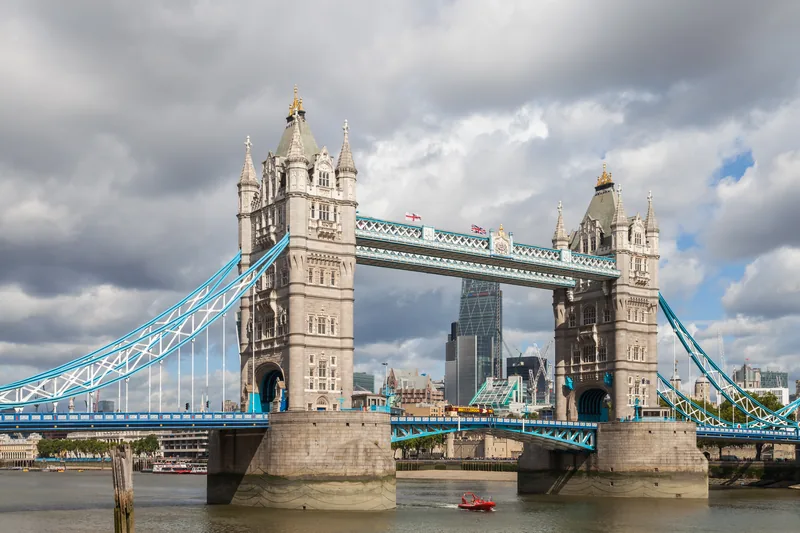
It is not a drawbridge
Drawbridges need ropes or chains. Tower Bridge’s roads were too heavy for that. It is a bascule bridge: two giant seesaws, each moving around an off-centre pivot, so that “no pressure is put on the Towers.” [source] [source]
The original colour was bright chocolate brown
The official facts page says so, and adds that it was “rumoured to be Queen Victoria’s favourite colour.” Battleship grey was applied as camouflage before the Second World War. The red, white and blue of today dates from the 1977 Silver Jubilee. [source]
The architect never saw it finished
Sir Horace Jones died one year into construction. Sir John Wolfe Barry completed the project, with Henry Marc Brunel as assistant engineer. [source] [source]
The first vessel through was called Daisy
The Harbour Master’s cutter went through first, after the Prince of Wales opened the Bridge at noon on 30 June 1894. [source]
141,760 pedestrians in a single day
On 9 July 1894 the Bridge was open to pedestrians only, from 5am to 9pm. Around 141,760 people crossed. The Bridge was lifted 13 times for 15 ships. [source]
It opened more than 6,000 times in its first year
By the late 1960s that had fallen to a few hundred times a year. The highest-ever number of lifts in one day is 64. [source] [source]
Ships still get a free lift, any day of the year
Under the 1885 Act, the Bridge must be raised, free of charge, for registered vessels with a mast or superstructure of 30 feet or more, given 24 hours’ notice, day or night, 365 days a year. [source]
Around 31 million bricks, and foundations almost eight metres down
Five major contractors and 432 construction workers each day built it over eight years. The first caisson was sunk almost 8m under the riverbed. [source] [source]
The glass floors can hold two black taxis
They were installed in the High-Level Walkways in 2014. The official facts page says they “can hold the weight of more than two black taxi cabs.” [source]
The walkways stand 42 metres above the Thames
They stretch 61m between the two Towers, the official construction timeline says. The crests on top of the Towers are almost 63m above road level and are gilded with gold. [source] [source]
Stokers worked in shifts, 24 hours a day
Three large boilers kept the steam up, until oil and electricity took over in 1976. The old pumping engines are still in the Victorian Engine Rooms. [source] [source]
The style was chosen to complement the White Tower
The official facts page is plain about the Neo-Gothic dress of the Bridge: it was chosen so that it sat well beside the Tower of London. [source]
Eight large cogs do the hard work
They are about a metre in diameter, four on each side, connected to a rack on the back of the bascules. Each side of each bascule is evenly balanced, so less energy is needed to open the roads. [source]
The Bridge is maintained at no cost to the taxpayer
It is owned and managed by the charity City Bridge Foundation, historically known as Bridge House Estates, which also looks after London, Southwark, Millennium and Blackfriars bridges. [source]
Keep exploring
Enjoyed the Bridge?
No pop-ups. No intrusive advertising. Just interesting stuff. A little support helps the next landmarks site get built.